
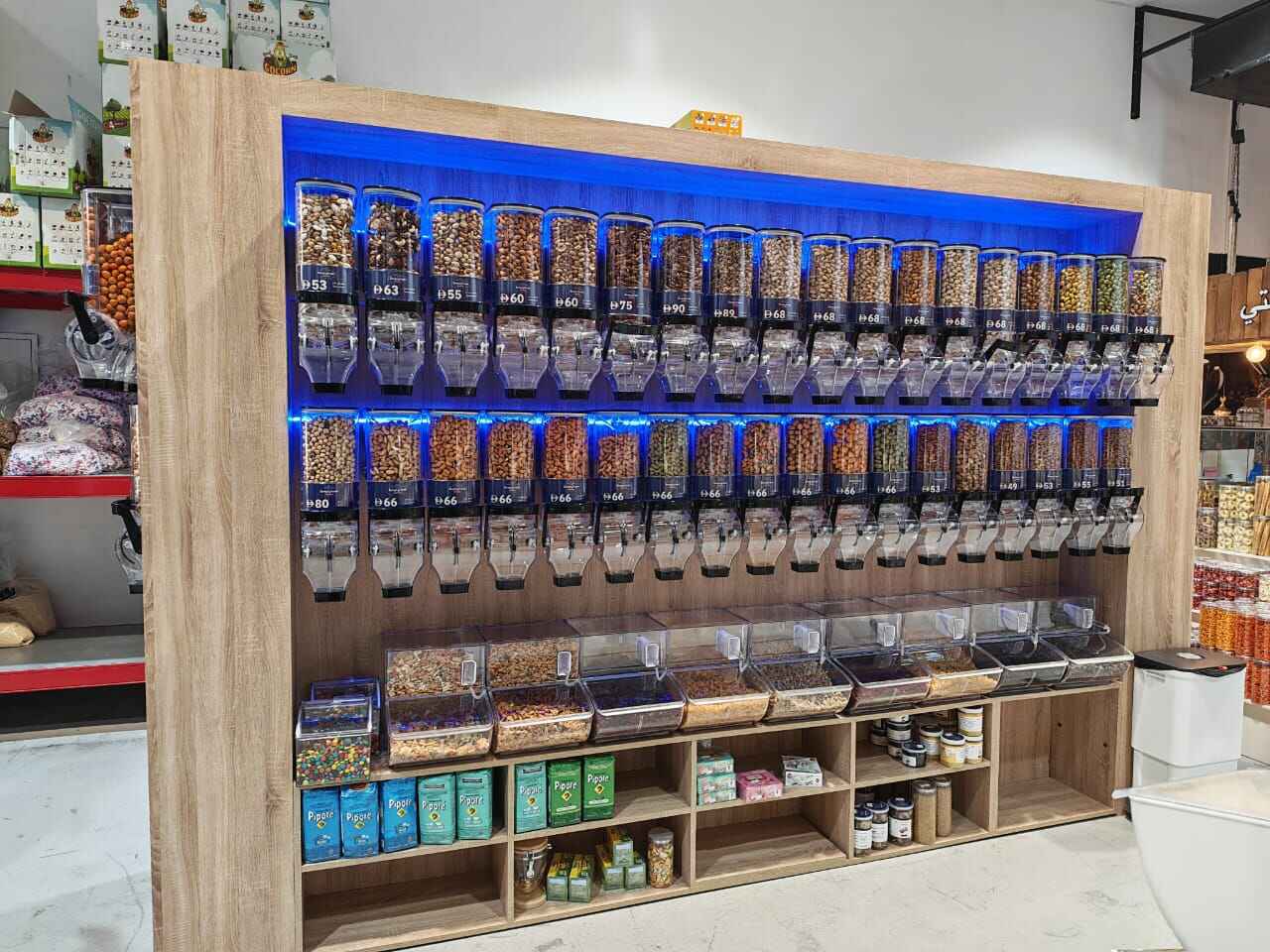
Strategic Placement for Maximum Efficiency and Customer Engagement
Optimizing High-Traffic Zones and Store Layout Flow
The best spots for dry food dispensers are where people naturally pass through - think store entrances, checkout lines, maybe even those sample stations. Why? Because these locations tend to get about 30 to 40 percent more attention compared to those out-of-the-way aisles. When setting up, try putting them next to things customers might want together. Like placing reusable containers right by the bulk grain section makes sense for shoppers looking to grab both at once. Also important: keep the machines visible within roughly ten to fifteen feet from where customers come in. Studies show around two thirds of last minute buys happen in busy areas. And don't forget basic common sense - nobody wants to bump into equipment while shopping.
Balancing Aisle Density, Dwell Time, and Accessibility
Overcrowded aisles reduce dwell time by 22%, while sparse layouts limit discovery. Strike balance with these evidence-based guidelines:
- Aisle width: Maintain 36 inches around dispensers to meet ADA wheelchair accessibility requirements
- Sightlines: Mount at 48–52 inches—average adult eye level—for optimal visibility
- Dwell triggers: Locate near “pause points” like coffee stations or recipe kiosks, where dwell time averages 2.3 minutes (double that of main aisles), correlating with a 17% sales lift per the Northeast Grocery Association
All operable parts must sit 48 inches high to comply with ADA standards.
Dry Food Dispenser Compatibility: Product Suitability and Flow Performance
Ideal Dry Foods: Grains, Nuts, Cereals, and Spices
Dry food dispensers perform best with free-flowing, low-moisture items: grains, rice, beans, seeds, nuts, cereals, spices, coffee, and tea. Gravity-fed systems preserve freshness by limiting air exposure. Avoid cohesive or hygroscopic materials exceeding 12% moisture content—clumping disrupts accuracy and increases maintenance.
Critical Physical Criteria: Moisture Content, Particle Size, and Flow Consistency
Three physical properties determine compatibility:
- Moisture content: Keep below 10% to prevent microbial growth and clumping
- Particle uniformity: Particles >1 mm (e.g., whole grains) flow reliably; fine powders require auger-assisted dispensing
- Flow consistency: Measured by angle of repose—under 30° indicates optimal flowability
High-abrasion products (e.g., rock salt) accelerate wear; oils in nuts demand FDA-grade seals. Always match bulk density (kg/m³) to your dispenser’s volumetric capacity.
Mounting Options and Operational Impact: Countertop vs. Wall-Mount Dry Food Dispensers
Countertop and wall-mount configurations serve distinct operational needs. Countertop models offer plug-and-play flexibility—ideal for pop-ups, seasonal displays, or sampling stations at checkout counters—while wall-mounted units maximize floor space and enhance visibility in tight urban stores. Vertical mounting also reduces accidental spills from customer contact.
Key operational distinctions:
| Factor | Countertop Dispenser | Wall-Mount Dispenser |
|---|---|---|
| Space Efficiency | Uses valuable horizontal surface area | Frees counter space completely |
| Installation | Minimal setup; no tools required | Requires secure wall anchoring |
| Customer Reach | Optimal for children and ADA-compliant access | May require step stools if mounted too high |
| Relocation Flexibility | Easy to move for layout changes | Permanent installation; limited repositioning |
Commercial kitchens often choose wall-mounted units near cooking stations to maintain sterile prep surfaces; boutique grocers favor countertop versions for interactive sampling. In earthquake-prone regions, always verify wall-mount weight capacity and seismic anchoring compliance.
Hygiene, Safety, and Regulatory Compliance for Dry Food Dispensers
Seal Integrity, FDA-Grade Materials, and Routine Cleaning Protocols
Keeping those seals in good shape is really important if we want to keep out bugs and dampness, especially when storing things like flour, rice, or spices where moisture can ruin everything. For storage containers, go with materials that won't rust or grow mold over time. Stainless steel that meets FDA standards works great, or alternatively look at food grade plastics that stand up to cleaning chemicals without breaking down. Don't forget regular maintenance either. Wipe down outside surfaces every day and give those hopper areas a thorough scrub once a week with sanitizers approved for food contact. Some recent research from 2023 showed something pretty impressive actually - containers with undamaged seals had way less bacteria problems compared to ones where the seal was broken. We're talking around 92% fewer issues according to their findings. And remember to swap out those rubber gaskets at least twice a year. They do wear out eventually and once they start failing, all that careful sealing goes right out the window.
NSF/ANSI 8 and FDA 21 CFR Part 110 Requirements Explained
NSF/ANSI 8 certification confirms dispenser design prevents contamination harborage—requiring smooth, crevice-free surfaces. FDA 21 CFR Part 110 outlines Current Good Manufacturing Practices (CGMPs), mandating:
| Requirement | Purpose | Enforcement Focus |
|---|---|---|
| Material non-toxicity | Prevent chemical leaching into food | Third-party certification |
| Drainage-enabled design | Eliminate stagnant moisture | Facility inspections |
| Tool-free disassembly | Enable thorough cleaning access | Audit documentation |
Materials must comply with FDA 21 CFR 177 for food contact. Operators must validate certifications, maintain cleaning logs, and understand that non-compliance under the Food Safety Modernization Act carries fines up to $50,000 per violation.
FAQ
Where should I place dry food dispensers for best results?
Place them in high-traffic areas such as store entrances and checkout lines to get 30-40% more attention than in less frequented aisles. Ensure they are visible within ten to fifteen feet from where customers enter.
Which dry foods are ideal for dispensers?
Free-flowing, low-moisture items such as grains, nuts, cereals, and spices are best. Avoid materials with over 12% moisture content to prevent clumping and maintenance issues.
How should I maintain my dry food dispensers to ensure hygiene and safety?
Regularly clean and maintain seals, using FDA-grade materials like stainless steel or food-grade plastics. Wipe down surfaces daily and sanitize weekly to prevent bacterial growth and ensure compliance with hygiene standards.


